

If you are searching “ADU Rules and Regulations Klickitat County,” you probably have one real question:
Can I actually put a second, legal dwelling on my property without stepping on a land use landmine?
Yes, you can. But Klickitat County’s ADU rules are not the loose, anything-goes version people assume. The County allows ADUs to expand housing options while protecting neighborhood character, and the rules read like a checklist that must be satisfied.
Below is a practical, plain-English breakdown of what the County requires, what the process looks like, and the specific standards that tend to surprise property owners.
If you want to skip the learning curve, start with Wolf’s free property evaluation. Submit your address and we will help you confirm feasibility, surface the likely constraints early (zoning, site layout, utilities, setbacks, critical areas), and map the cleanest path forward.
What Counts as an ADU in Klickitat County?
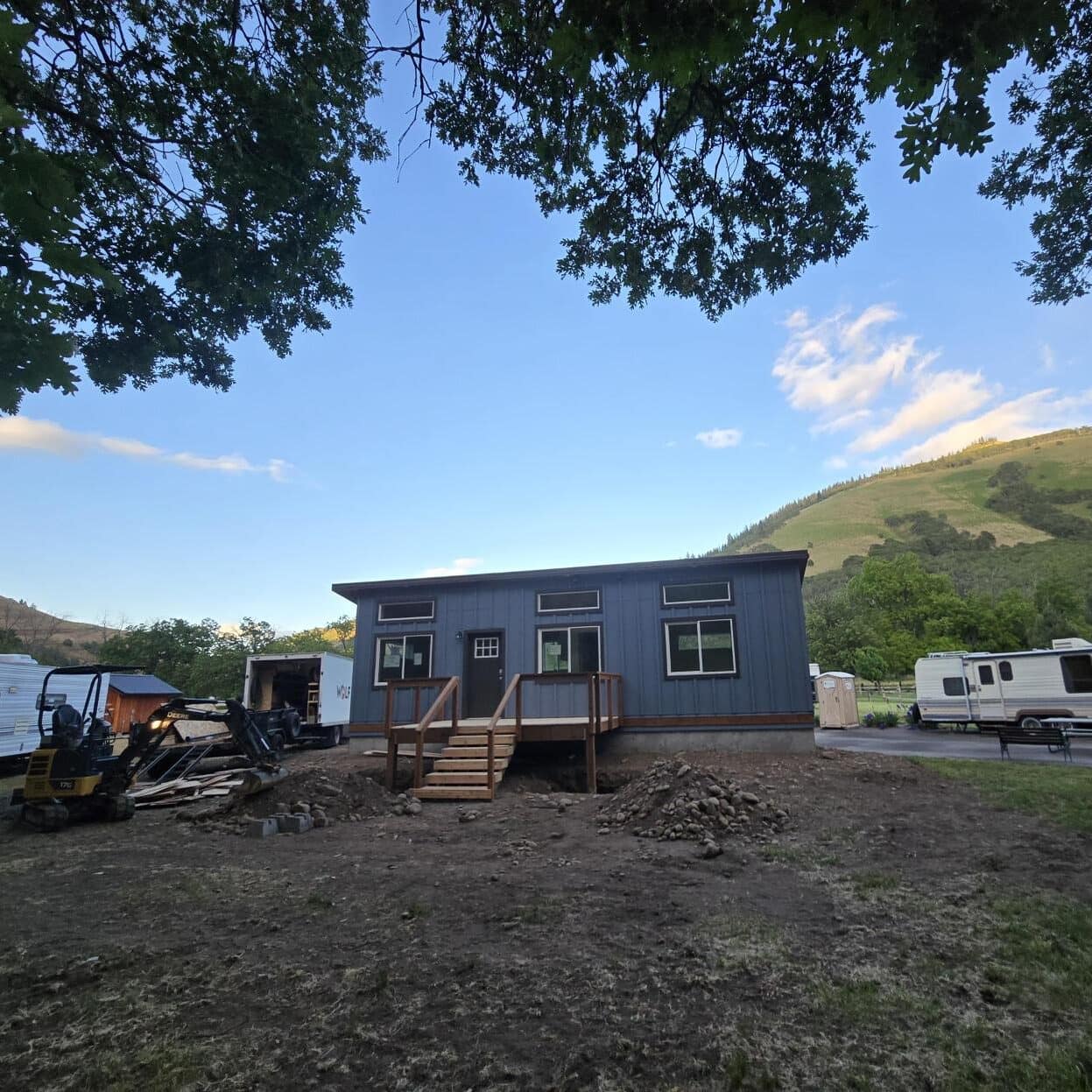
Klickitat County defines an accessory dwelling unit (ADU) as a habitable living unit that is subordinate to the principal dwelling unit. It can be:
- An attached unit added to an existing or proposed principal home
- A detached unit on the same parcel as the principal home
If it is detached, the County requires it to be completely within 200 feet of the primary residence.
Translation: you do not get to tuck a second house way back on the far end of acreage just because you have the space.
Where ADUs Are Allowed in Klickitat County
An ADU may be authorized through an administrative conditional use process when criteria are met.
Klickitat County’s ADU provisions apply in zoning districts where a single-family dwelling is a permitted use, including:
- Forest Resource (FR)
- Open Space (OS)
- Extensive Agriculture (EA)
- General Rural (GR)
- Rural Residential (RR)
- Rural Center (RC)
- Suburban Residential (SR)
- Rural (RRL)
There are also noted exceptions related to specific sub-areas mentioned in County ordinance language. If you are not sure what zone you are in, do not guess. Zoning drives whether a principal single-family dwelling is permitted outright and whether an ADU can even be considered.
So, before you sketch floor plans or price out a build, confirm your jurisdiction and what type of zoning district you are in. Start with Wolf’s free property evaluation to see your clearest path forward.
The Big Rules Most People Miss
1) You Only Get One ADU per Principal Unit (and the parcel cannot already be “stacked”)
Klickitat County rules state:
- Only one ADU may be established per principal unit in single-family zones
- Only if there are no other existing dwellings on the parcel
That means if your property already has multiple dwellings beyond the primary residence, an ADU may not be an option under this standard.
2) Owner Occupancy Is Required
The property owner (including title holders and contract purchasers) must occupy either the principal unit or the ADU as their permanent residence for at least 6 months out of each year.
This is not written like a suggestion. It is a core requirement.
3) The Parcel Cannot Be Split to Separate the ADU from the Main Home
The parcel owner must agree not to divide the parcel in a way that places the ADU and the principal dwelling on separate parcels.
In other words, an ADU is meant to stay accessory. It is not a shortcut to creating two separate lots.
4) Size, Bedrooms, and Basic “Livability” Standards
Klickitat County limits the ADU to:
- No more than 2 bedrooms
- A maximum floor area limit is specified in County ordinance language (commonly shown as 900 square feet in earlier ordinance text and updated language reflecting a different maximum in later amendments)
- A ceiling height requirement appears in the amended ordinance text: a ceiling height of not less than 7 feet measured from the finished floor to the lowest projection
- Floor area calculations include spaces such as mezzanines or lofts, hallways, bathrooms, toilet rooms, and laundry rooms
- Square footage calculations generally do not include covered porches, decks, carports, or garages
If you are planning a loft, a big hallway, or oversized utility and laundry areas, understand that those may count toward maximum floor area.
5) Detached ADU Placement: The 200-Foot Rule
If detached, the ADU must be located completely within 200 feet of the primary residence.
This is one of the most important site planning constraints because it impacts driveway layout, utilities, septic placement, and overall site design.
6) Water Supply: You Cannot Just Drill a New Well for the ADU
County ordinance language requires:
- Certification from the County Health Department or responsible water purveyor that the water supply is adequate to serve both the principal unit and the ADU
- The ADU is required to utilize the existing well as the source of potable water supply
- No additional well shall be drilled to accommodate the ADU
- Landowners are strongly encouraged to meter the well and document water usage monthly to help demonstrate compliance with state groundwater exemption limitations
If your current well is marginal, this becomes a major feasibility issue.
7) Septic: The Parcel Must Support It
The parcel must exceed the minimum usable land area requirement for an on-site sewage system, and the primary and reserve sewage disposal systems for the principal unit and ADU must be able to be accommodated within the parcel’s lot lines.
This is where many rural ADU plans fall apart. It is not just “can I build it,” it is “can I legally handle sewage disposal for it.”
8) Parking and Access: No New Road Approach
County rules state:
- One off-street parking space, in addition to what is required by the underlying zone, shall be provided (or as many spaces deemed necessary by the Planning Department to accommodate actual vehicle use)
- Parking can include garages, carports, or other off-street parking areas
- The driveway of the existing or proposed principal dwelling shall be used as the driveway to serve the ADU
- A new driveway or road approach to a public or private access road is not permitted
If your ADU plan assumes a second access point, plan on redesigning.
9) Design Compatibility: It Has to Read Like One Single-Family Property
The ADU must be designed and placed so that, to the degree reasonably feasible, the appearance of the building and lot remains that of a single-family residence. If your concept looks like a separate rental compound, expect pushback.
10) Legal Strings Attached: A Recorded Restrictive Covenant
A condition of ADU approval is that the parcel owner must record a restrictive covenant (reviewed and approved by the Planning Department) that attaches to the title and binds future owners and occupants to the ADU conditions. This is how the County ensures the ADU standards survive a property sale.
11) Short-Term Rentals: Not Allowed Under the Standard
County ordinance language states that neither the principal unit nor the ADU shall be used as short-term vacation rentals, defining short-term vacation rental as a rental that is less than 60 consecutive days in a single 12-month period. If your entire plan is “Airbnb the ADU,” this restriction matters.
The ADU Approval Process in Klickitat County
Klickitat County’s ADU brochure lays out a process that is more formal than many people expect.
Pre-submission meeting is required
A pre-submission meeting with Planning Department staff is required before you even receive application forms.
Administrative conditional use permit (CUP) process
Once a completed application is accepted, it is routed to:
- Adjacent landowners
- Interested parties
- Applicable agencies
The Planning Department can grant approval if the proposal demonstrates it will not be substantially detrimental to the public interest and is consistent and compatible in design, character, and appearance with surrounding development.
Timeline: plan for about 60 days
The County advises allowing approximately 60 days from start to finish due to public notice requirements and agency review time.
You cannot start early
You may not start the project before the administrative CUP is effective. The applicant is responsible for obtaining all other applicable permits before construction begins.
Build deadline: 2 years or the approval can lapse
If the ADU is not constructed and a certificate of occupancy issued within two years, the administrative conditional use permit approval can lapse.
Cost (base fee)
The County brochure lists a base permit fee of $500 for an administrative conditional use application (other permits and costs still apply).
Practical ADU Planning Checklist for Klickitat County

Use this to pressure-test your property before you spend money on design.
- Confirm your zoning allows a single-family dwelling as a principal permitted use
- Verify there is only one existing dwelling on the parcel (if in a single-family zone)
- Plan for exactly one ADU per principal unit
- Confirm the ADU can be within 200 feet of the primary residence if detached
- Confirm septic feasibility, including primary and reserve areas within the lot lines
- Design for no more than two bedrooms
- Design within the maximum floor area standard stated in County ordinance language
- Plan at least one additional off-street parking space
- Plan to use the existing driveway (no new access approach)
- Assume you will need to record a restrictive covenant
- Do not assume the ADU can be used as a short-term vacation rental
To skip the guess work you can let Wolf handle all this for you by starting with Wolf’s free property evaluation to see your clearest path forward.
Frequently Asked Questions: ADU Rules and Regulations Klickitat County
Can I build a detached ADU anywhere on my land?
Not under the County’s detached placement standard. Detached ADUs must be completely within 200 feet of the primary residence.
Can I build an ADU and keep it as a full-time rental?
The rules require owner occupancy of either the primary home or the ADU for at least 6 months per year. That still allows a long-term rental arrangement in many cases, but it is not designed for absentee ownership.
Can I use the ADU as a short-term rental?
County ordinance language restricts short-term vacation rentals, defining them as rentals less than 60 consecutive days in a 12-month period.
Do I need a conditional use permit?
Klickitat County describes ADU authorization through an administrative conditional use process when criteria are met.
How long does approval take?
The County recommends allowing about 60 days for the administrative process, assuming your submittals are complete and you are responsive.
If you want to skip the guessing and experience a turn-key ADU process, start with Wolf’s free property evaluation.
Final Take: Klickitat County Allows ADUs, But Only the “Accessory” Version
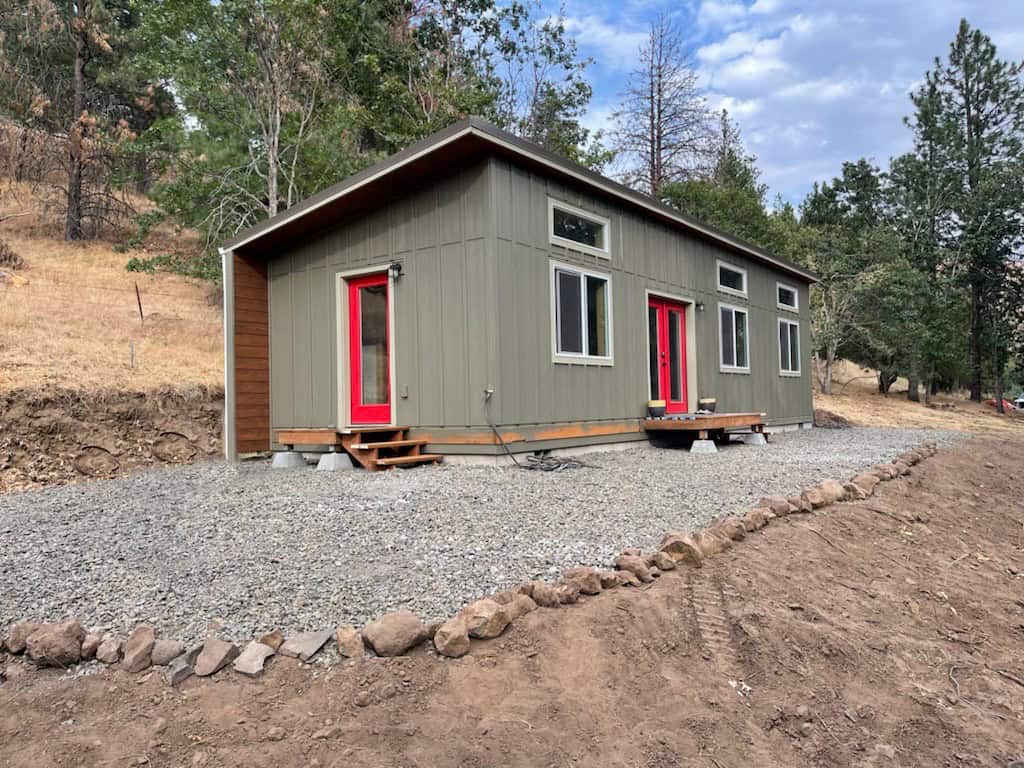
Klickitat County’s rules are built around one theme: the ADU must remain subordinate to a single-family property, and it must not function like a second independent development site.
If you respect the limits (200-foot placement, owner occupancy, water and septic feasibility, parking and driveway rules, size and bedroom caps), an ADU can be a powerful way to add housing flexibility and long-term value. If you try to treat the ADU like a loophole for a second stand-alone home, the regulations are designed to shut that down.
If you are serious about building an ADU in Klickitat County, do not start with guesses. Start with a clean feasibility read from a builder who has built in Klickitat County and has built over 600 homes and ADUs throughout the Pacific Northwest.
Fill out Wolf’s free property evaluation and we will help you understand what is realistic on your specific parcel, what the permitting path looks like, and how to avoid expensive missteps:
https://wolfind.com/contact/property-evaluation/
Sources
Klickitat County Planning Department, “Accessory Dwelling Unit (ADU) Brochure (2018)”
https://www.klickitatcounty.gov/DocumentCenter/View/5215/ADU-brochure-2018
Klickitat County, “Accessory Dwelling Unit Ordinance” (Ordinance No. 072214-1 and Attachment A)
https://www.klickitatcounty.gov/DocumentCenter/View/337/Accessory-Dwelling-Unit-Ordinance-?bidId=#:~:text=The%20ADU%20is%20required%20to%20be%20located%20within%20two%20hundred,not%20designed%20for%20transient%20accommodation.
Klickitat County, “ADU Ordinance 0071718-2” (Ordinance No. 0071718-2, Exhibit A amendment text)
https://www.klickitatcounty.gov/DocumentCenter/View/4948/ADU-Ordinance-0071718-2#:~:text=The%20proposed%20ADU%20shall%20comply%20with%20all,to:%201.%20Expand%20opportunities%20for%20affordable%20housing