
Battle Ground WA ADU (accessory dwelling unit) Rules and Regulations: What Homeowners Need to Know Before Building an ADU
Battle Ground ADU rules under BGMC 17.135.010: up to two ADUs, a 1,200 sq ft cap, 5-foot side and rear setbacks, one parking space, and the permit steps.
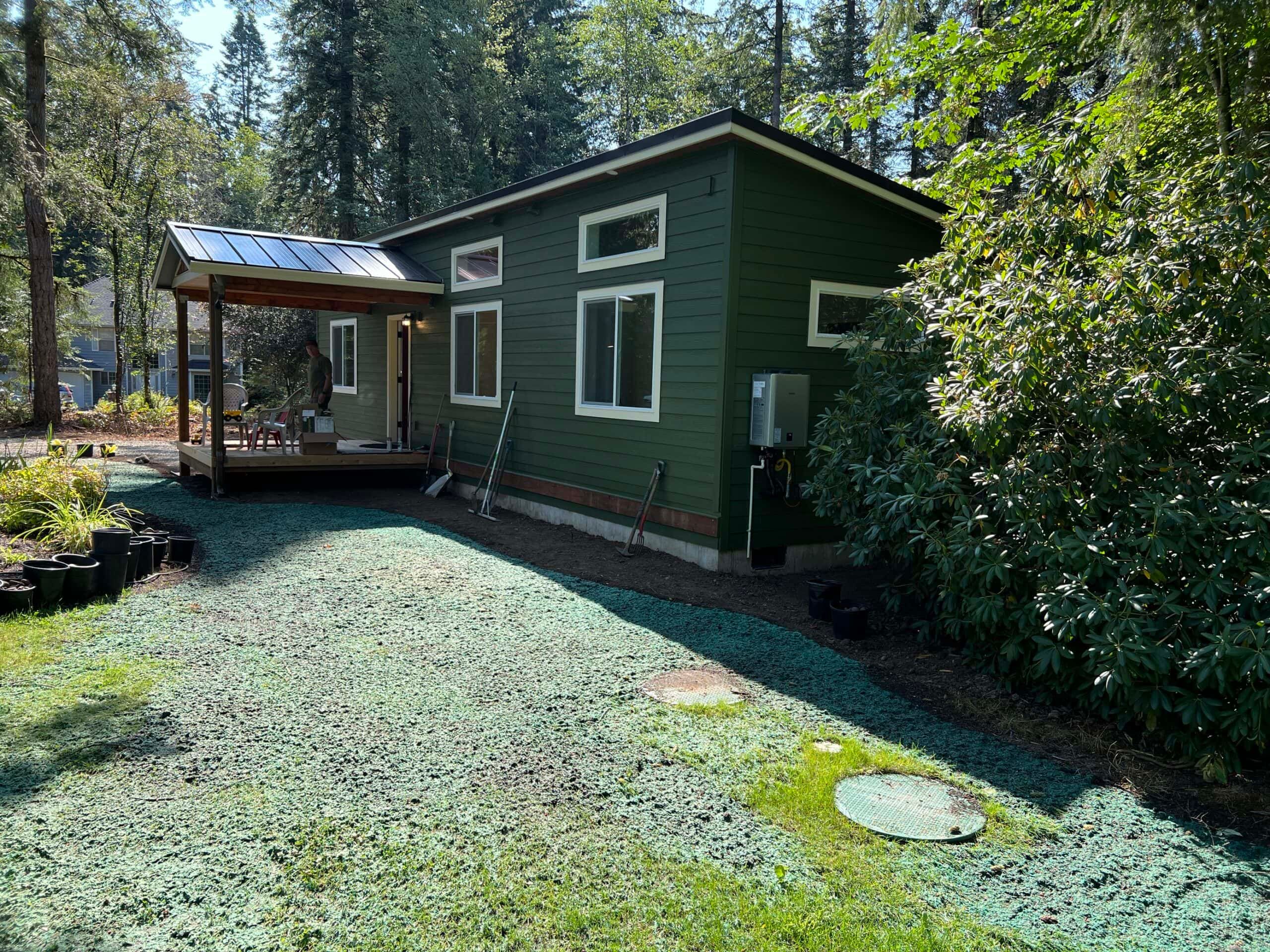
Battle Ground is where every Wolf home is built, in our factory at 607 SE Eaton Blvd. It’s also a city with its own ADU code, surrounded by rural land that shares the Battle Ground mailing address but isn’t in the city.
These are the City of Battle Ground’s rules, from Battle Ground Municipal Code (BGMC) 17.135.010 as amended by Ordinance 25-08 in 2025. If your lot turns out to be in unincorporated Clark County, the county’s rules apply instead; they’re in our Clark County ADU rules guide. For how we build in town, see ADU builder in Battle Ground.
What an ADU is in Battle Ground WA
An accessory dwelling unit is a second, complete home on a residential lot, with its own kitchen, bathroom, and sleeping area. In Battle Ground it can be attached to the house or detached. The code says the point is to give homeowners room for separate living quarters, whether that’s for an aging parent, a grown child, or someone else, and to add affordable housing in the city.
The rules are in BGMC 17.135.010. The city processes a proposed ADU as a Type I land use action.
Where ADUs are allowed
ADUs are allowed in all of the city’s residential zones: R3, R5, R7, R10, R12, R16, and R20. The code doesn’t allow an ADU with an existing house that sits in a nonresidential zone.
Confirm the lot is inside city limits first. Look the parcel up on Clark County GIS or in the county’s Property Information Center. The account page shows the zone and links to the city’s code. Parcels out toward Brush Prairie, Fargher Lake, and Ariel often carry a Battle Ground address and still file with Clark County.
How many ADUs a lot can have
Up to two, in any of these combinations:
- One attached ADU and one detached ADU
- Two attached ADUs
- Two detached ADUs, in one building or two
That matches Washington’s ADU law, RCW 36.70A.681, which requires cities to allow two ADUs on lots in urban growth areas zoned for single-family homes. Whether two fit on your lot comes down to coverage, setbacks, parking, and utilities.
Size requirements for Battle Ground ADUs
The code caps an ADU at 1,200 square feet of gross floor area, measured from finished wall to finished wall. The minimum is whatever the International Residential Code requires for a dwelling.
The city’s ADU FAQ page still lists an older rule: an attached addition or detached structure can be no more than 40 percent of the house’s square footage (not counting the garage), up to 1,000 square feet. That rule is out of date. The code section was amended after it was written, and state law (RCW 36.70A.681) doesn’t let a city cap an ADU below 1,000 square feet. Plan to the 1,200-square-foot limit in the code.
A new ADU also gets a 10 percent lot coverage bonus under BGMC Table 17.106-2. Everything else about coverage follows the zone, in BGMC 17.106.030.
Wolf’s Models K, E, F, J, and L run from 432 to 984 square feet, all under the cap. The Model I is published at 1,232 square feet, but that’s its outside footprint, 28 by 44 feet. Measured from finished wall to finished wall, the way Battle Ground’s code measures an ADU, it comes to roughly 1,150 square feet with 2×6 walls, under the cap. We confirm that measurement with the city before proposing it as an ADU.
Height and setback rules
The setbacks in BGMC 17.135.010:
- At least 5 feet from side and rear property lines.
- The same front setback as the house.
- A detached ADU can sit at a lot line that backs onto a public alley, unless the city routinely plows snow in that alley.
- An existing structure, such as a detached garage, can be converted to an ADU even if it doesn’t meet today’s setback or lot coverage rules.
The ADU section doesn’t set a height limit of its own, so the zone’s limit applies. Under BGMC Table 17.106-2, that’s 35 feet in the R3 through R10 zones and 45 feet in R12 through R20. State law doesn’t let a city hold an ADU to a roof height under 24 feet unless the house itself is limited to less.
Property lines aren’t always where the fence is. Easements and critical areas can also shrink the pad, and the code doesn’t let an ADU encroach into a critical area or its buffer beyond what BGMC 18.260 allows.
Parking requirements for ADUs in Battle Ground
BGMC 17.135.010 requires one additional off-street parking space for the ADU, and the house keeps whatever parking the code already requires for it. The city’s FAQ says the same. Put the extra stall on the site plan from the start, and make sure it doesn’t block the path a module needs to reach the pad.
Design and appearance standards
The code asks for architectural treatment similar to the house’s, and a detached ADU has to sit on a permanent foundation. The FAQ says the ADU should be consistent with the primary dwelling. State law also says a city can’t hold an ADU to stricter aesthetic or design review standards than the house.
On a Wolf home, matching the house usually comes down to siding color, trim, and a gable or shed roof. Fiber-cement lap siding is standard, and board-and-batten siding and a standing-seam metal roof are upgrades in the Options Book.
Owner occupancy rules
Battle Ground’s ADU code doesn’t require the owner to live on the property, and Washington law now prohibits that requirement. You can live in the house and rent the ADU, live in the ADU and rent the house, or rent both. Check the city’s current rules before you plan on short-term rentals, since those are separate from the ADU permit.
The code also says the city can’t block the sale of a condominium unit just because it was originally built as an ADU.
Utilities and access requirements
An ADU needs working kitchen, bathroom, and sleeping areas and its own utility connections, built to the building, plumbing, electrical, mechanical, fire, and health codes. A few Battle Ground specifics:
- Address. The city doesn’t issue a separate street number. The ADU gets the house’s number followed by “A,” such as 1234-A, posted where it’s visible from the ADU’s entrance. If that entrance can’t be seen from the street, the address also goes on the house, or at the driveway on a flag lot. Numbers are 4 inches tall with a stroke at least half an inch wide.
- Electrical permits. Electrical permits and inspections go through Washington L&I, not the city.
- Street improvements. The city can’t require public street improvements as a condition of the ADU permit.
The ADU permit process in Battle Ground
- Confirm the jurisdiction and zone. Use GIS to make sure the lot is in the city and to find its zone.
- Register on the city’s Customer Self-Service (CSS) portal. Applications are filed there.
- Pick the right application. The city’s FAQ separates custom-built ADUs from pre-fabricated ones, but it doesn’t separate a modular home approved by Washington L&I from a HUD manufactured home, and the manufactured-home placement rules were written for multi-section manufactured homes. A Wolf home is a modular home built to the IRC, so we get the planning department’s answer in writing on which application it goes through before we apply.
- Submit plans. Upload the documents, then deliver one full-size (24 × 36), to-scale set of plans and one copy of the other documents to the city, labeled with the permit number.
- Pay fees. The FAQ bases a custom-built ADU’s fees on valuation and a pre-built ADU’s on the manufactured home placement fee, both from the city’s current fee schedule. Which one a Wolf home pays follows the application the city assigns it.
- Inspections. City inspections cover the foundation, placement, and utility connections. Electrical inspections come from L&I.
Soil management worksheets and an erosion control plan are part of the packet, except for an ADU built inside the existing footprint of the house.
Cost and timeline expectations
The fees are set by the city’s fee schedule, as described above. Most of the rest of the budget is the home and the site work. The Model K starts at $85,500 for the home itself. Permits, delivery, installation, and site work such as trenching, sewer, and an electrical upgrade are priced after we see the lot. The Washington ADU cost guide has typical ranges.
While the home is built in the factory, the foundation and utility work can go ahead on site, so the yard is torn up for less time than with a home framed in place.
Building a Wolf ADU in Battle Ground
Wolf homes are modular, built to the same IRC and IBC codes as a site-built house. Washington L&I reviews the factory plans and oversees inspections in the plant, and each home carries its L&I insignia before it ships. The city still reviews and inspects the foundation, placement, and utility connections.
The people who design, permit, build, and set your home all work out of the Eaton Boulevard factory, and we’ve delivered more than 40 homes in and around Battle Ground since 2021, including ADUs inside city limits. A few of them are in our case studies. A delivery in town is a short local move, and warranty visits don’t need a hotel.
Get started with a free property evaluation
Before you spend money on a floor plan, find out what the lot can take: city or county, the zone, the setbacks, where the parking stall goes, and how the module gets to the pad. Send us the address and tell us how you plan to use the ADU.
Common questions
How big can an ADU be in Battle Ground?
How many ADUs can I build on a Battle Ground lot?
What setbacks does Battle Ground require for an ADU?
Does a Battle Ground ADU need its own parking space?
Do I have to live on the property?
Is a Battle Ground mailing address always a city permit?
Sources
Requirements change, so check the current forms and rules with your jurisdiction before you file. This is general information, not legal advice.
- Battle Ground Municipal Code 17.135.010 — Accessory dwelling units (Ord. 25-08, 2025)
- Battle Ground Municipal Code Table 17.106-2 — Residential zone dimensional standards
- City of Battle Ground — Accessory Structures & ADU FAQ
- Clark County GIS maps
- RCW 36.70A.681 — Accessory dwelling units, limitations on local regulation
- Washington L&I — factory-assembled structures